
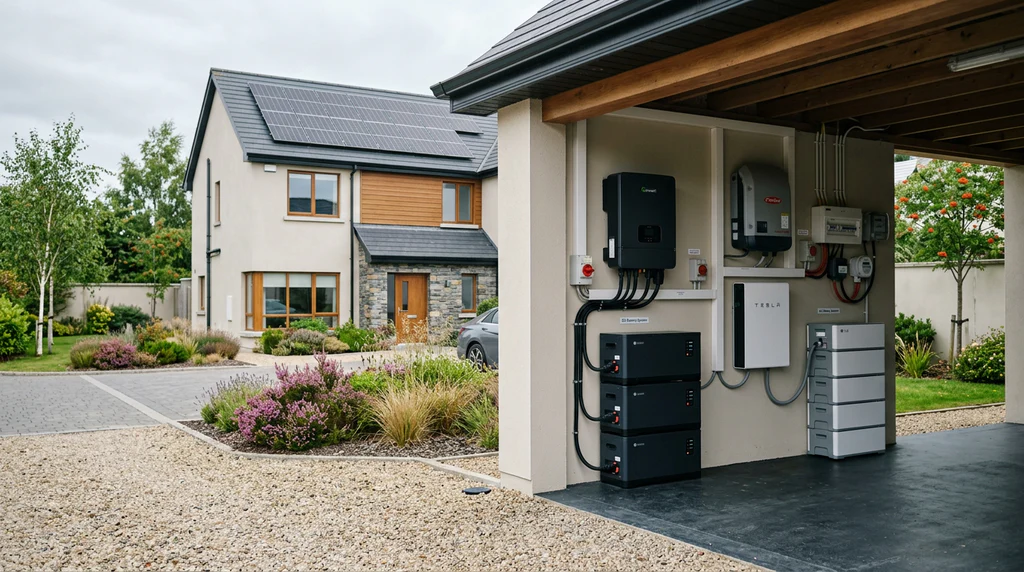
Solar Battery Storage for Home Cost: What Changes the Quote?
Two neighbors can ask for “a solar battery” and receive quotes that are thousands of dollars apart. That does not always mean one installer is padding the bill. Storage cost depends on the electrical panel, backup expectations, battery capacity, inverter power, software, permitting, and the messy details hidden inside the garage wall.
Battery price headlines are useful, but they are not the same as the installed home storage cost. BloombergNEF reported that average lithium-ion battery pack prices reached $108 per kWh in 2025, with stationary storage packs lower than the all-segment average. A homeowner cannot buy a bare pack and call the project finished.
The Three Numbers That Shape the Quote
The first number is usable battery capacity, measured in kWh. It tells how much energy can be stored and later used. The second is power output, measured in kW. It tells how many loads can run at the same time. The third is backup scope: essential loads, partial-home backup, or whole-home backup.
According to NREL, storage duration depends on both power and usable energy. A 10 kWh battery may last many hours with light loads or disappear quickly under heavy air-conditioning demand. That is why installers ask about appliances, not just square footage.
The residential energy storage product lineup gives a useful way to compare these variables because different models sit at different power levels while allowing modular battery expansion.
Hardware Is Only Part of the Price
A complete quote may include:
- Battery modules and inverter
- Backup gateway or transfer equipment
- Electrical labor and permits
- Critical-load panel work
- Monitoring and commissioning
- Fire-code and spacing requirements
Older homes can add cost if the main panel is full, service capacity is tight, or long conduit runs are needed. A tidy new garage with an updated panel is a different job from a 1970s house with limited wall space and a crowded utility room.
The Department of Energy’s solar cost benchmark work treats PV and storage costs as full system costs, not just component prices. That is the right lens for homeowners. The installed system is what delivers backup power, safety controls, and day-to-day operation.
Why Larger Output Costs More
Some buyers focus only on kWh because it feels like “battery size.” But kW output can change the quote just as much. Running a refrigerator and lights is one thing. Starting a central air conditioner, well pump, or large induction cooktop is another.
A higher-output single-phase option, such as the HM12 single-phase system, may fit homes where the owner wants more power available at once, while still keeping capacity modular.
The Software Question
Software should not be treated as a decorative feature. A battery that charges and discharges at the wrong time can miss savings, drain before an outage, or export power when the homeowner expected self-use. Monitoring helps show solar production, household consumption, grid import, and battery state of charge.
That matters most in homes with time-of-use rates, EV charging, or changing seasonal loads. A battery installed for backup alone may sit idle. A battery managed for daily use can help shift solar into evening hours and reduce peak-rate purchases.
A Better Way to Compare Quotes
The cleanest comparison is not total price alone. Ask what the quote backs up, how long it is expected to run under specific loads, what equipment is included, whether solar can recharge the battery during an outage, and how the system will be monitored.
A lower quote that excludes panel work, backup hardware, or enough output for the stated loads may not be cheaper in the end. A higher quote may be reasonable if it solves the actual backup and energy-management problem.