
Top 10 Guest Post Marketplaces in 2026: Where to Buy And Sell Sponsored Articles Without The Chaos
Guest posting still works in 2026, but the process has changed. Cold outreach is slower than ever, inboxes are saturated, and editors are increasingly strict about relevance and quality. At the same time, brands and agencies need predictable placements, clean workflows, and fewer “maybe we’ll publish next month” surprises.
That’s why the modern guest post marketplace exists: a structured way to connect advertisers (buyers) with publishers (sellers) using searchable inventories, clear requirements, and trackable orders. Some platforms focus on classic guest posts on blogs. Others lean toward digital PR placements on news sites. A few try to do everything, guest posts, link insertions, press releases, and more.
This ranking focuses on marketplaces that make it realistic to run ongoing campaigns: scalable discovery, transparent rules, and a process that doesn’t rely on dozens of separate conversations.

What Does a Guest Post Marketplace Actually Solve?
At a practical level, these platforms replace three painful parts of traditional outreach:
- Discovery: Instead of hunting for sites manually, you filter a catalog by language, niche, and metrics.
- Process: Instead of endless emails, you send briefs, upload content, and track statuses in one place.
- Risk control: Many marketplaces add moderation, guarantees, escrow-like protection, or refund policies.
Done right, marketplaces help you stay consistent, one of the most overlooked factors in sustainable Search Engine Optimization (SEO). Done incorrectly, they become a “buy links fast” trap that creates low-quality footprints. The best platforms make quality the default, not an optional upgrade.
How Was This Ranking Built?
To keep the comparison useful, the criteria focus on what matters when you run campaigns repeatedly (not just once):
- Inventory fit: Variety of niches, languages, and formats (guest posts vs. media placements vs. insertions).
- Filtering & transparency: Whether you can evaluate sites before ordering (metrics, categories, rules, turnaround).
- Quality control: Vetting, moderation, and policies that reduce spam and “thin content” placements.
- Workflow: Briefing, messaging, content upload, revisions, and status tracking.
- Commercial model: How you pay (cash, credits, deposits) and how predictable costs are.
- Support for modern visibility: Not only classic SEO links, but also brand mentions and authority signals that help in AI-driven discovery (often called Answer Engine Optimization, AEO).
Note: The list is intentionally broad because “guest post marketplace” in 2026 often overlaps with sponsored content marketplaces and digital PR catalogs. If your goal is to publish strictly editorial guest articles on blogs, focus on platforms that emphasize niche relevance and long-term publication guarantees.
The 10 Best Guest Post Marketplaces (Ranked)
1) GUESTPOSTLINKS
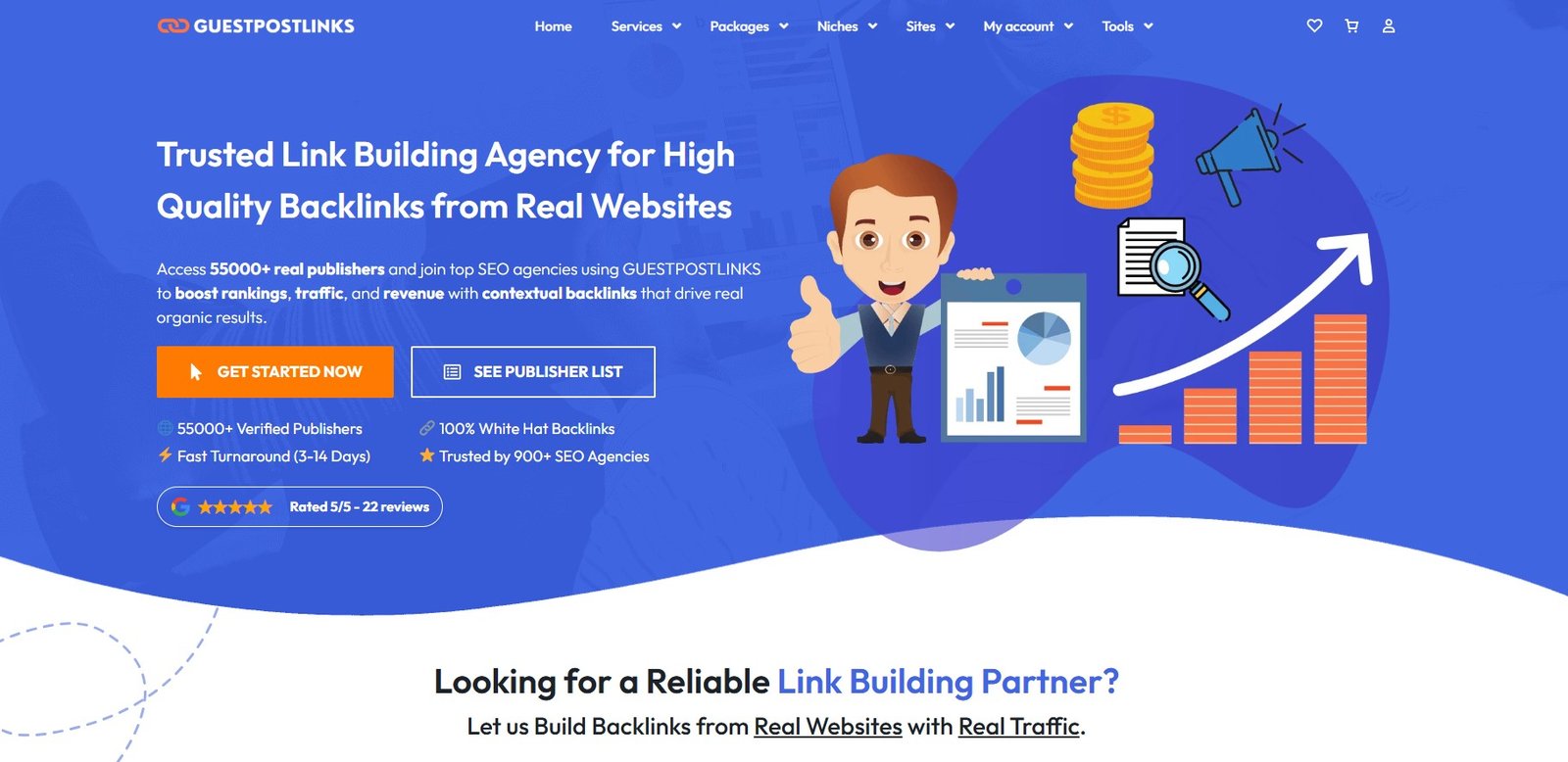
GUESTPOSTLINKS is a guest posting and link-building platform that gives brands, agencies, and SEO professionals direct access to 55,000+ vetted publishers across multiple niches, countries, and languages. The platform makes it easy to secure high-quality backlinks through guest posts, niche edits, local citations, and PR placements from one centralized dashboard.
Its network is built around real websites with verified traffic, transparent metrics, fast turnaround times, and flexible campaign management. From single placements to large-scale outreach campaigns, GUESTPOSTLINKS helps businesses acquire relevant backlinks without the time and cost of manual outreach.
- Best for: Guest posting, niche edits, local citation building, PR distribution, agency-scale link building, and businesses looking for niche-relevant backlinks from real publishers.
- Watch for: Reviewing publisher metrics, traffic quality, niche relevance, and placement strategy to ensure backlinks align with your SEO goals and authority-building plans.
2) PressBay

PressBay stands out with a distinct approach: a credit-based exchange model rather than traditional per-order payments. Publishers earn internal credits for publishing, which can be reinvested in placements elsewhere in the ecosystem.
This structure can be attractive to publishers who want promotion without constantly handling invoices and to marketers who want a predictable, repeatable workflow across many languages.
- Best for: Steady, long-term placement cadence; multilingual campaigns; teams that like a structured “earn-and-reinvest” loop.
- Watch for: Matching your campaign planning to a credit system (different from traditional media buying).
3) WhitePress

WhitePress is one of the most established marketplace-style platforms for content publication and link building across multiple countries. Its positioning emphasizes scale (large catalogs), multi-language support, and workflow tooling.
It’s also known for structured filtering and a more “platform” feel than ad-hoc outreach, which can be helpful for agencies running campaigns in many markets at once.
- Best for: Multi-country link building; teams that need a large catalog and consistent processes.
- Watch for: Treating it as a catalog-first tool, quality still depends on choosing relevant publishers, not just high metrics.
4) PRNEWS.IO

PRNEWS.IO leans into sponsored media placements and brand authority building, with a heavy focus on being featured across large media catalogs. If your strategy includes PR-style placements, mentions, citations, and reputational coverage, this type of marketplace can complement classic guest posting. It also aligns with the growing push toward visibility in AI answers (AEO), where credible media sources can matter beyond backlinks.
- Best for: Authority and PR-driven placements; international coverage; combining SEO with brand credibility.
- Watch for: Ensuring the publication type matches your content (editorial tone, disclosure rules, brand safety).
5) Linkhouse

Linkhouse is widely known in Europe as a link-building and sponsored article marketplace. The typical strengths of this platform style are strong filtering, structured publisher offers, and a clear buying workflow. For teams that already know what niches and anchor profiles they need, a marketplace like this can be an efficient way to scale placements without building a massive outreach operation.
- Best for: Structured link building workflows; buyers who want clear offer formats and repeatability.
- Watch for: Keeping content quality high and avoiding “template placements” that look the same across sites.
6) Collaborator

Collaborator combines classic website placements with additional channels (notably Telegram advertising), which makes it more of a multi-format marketplace than “guest posts only.” A notable emphasis is placed on verified analytics and structured deal flow, which can reduce uncertainty for buyers who are tired of unclear traffic claims.
- Best for: Teams combining SEO placements with broader distribution; campaigns that need verified data signals.
- Watch for: Staying focused, multi-format catalogs can tempt you into buying mismatched placements.
7) Accessily
Accessily positions itself as a streamlined guest post platform with a strong workflow: browse publishers, order, publish, and track. It’s often appealing to SEOs who want less negotiation and more “campaign control panel.” Some marketplace-style platforms in this category also add guarantees and post-publication monitoring to reduce risk.
- Best for: Agencies and in-house SEOs who want speed and a clean process without heavy outreach.
- Watch for: Avoiding over-optimization, keep anchor and placement patterns natural across campaigns.
8) Adsy
Adsy is known for offering guest post-style placements and related services (often including content writing options). Platforms like this are commonly used to scale mid-budget campaigns, where the goal is consistent publishing volume across relevant categories rather than just premium PR features.
- Best for: Scaling content placements with straightforward ordering; buyers who want optional content production.
- Watch for: Quality variance, focus on relevance and editorial rules, not only turnaround time.
9) Getfluence
Getfluence is closer to the “premium media” side of the spectrum, often discussed in the context of digital PR and brand authority. If your campaigns target recognizable publications, multi-country reach, and reputation-management signals, this type of marketplace can be a strong complement to niche blog guest posting.
- Best for: PR-style placements, premium publishers, international brand visibility.
- Watch for: Aligning content tone and expectations, premium outlets often require stronger editorial quality.

10) LinkPublishers
LinkPublishers positions itself as an AI-powered marketplace for link building and guest posting. Tools that emphasize automation can be useful for agencies managing many clients, especially when the platform helps standardize filtering, orders, and reporting. As always, automation helps most when your quality standards are defined upfront.
- Best for: Teams that want a more automated platform feel, agencies juggling multiple projects.
- Watch for: Relying on automation alone, human review of publisher relevance still matters.
11) Icopify
Icopify presents itself as a marketplace for guest posting and blogger outreach. This category is often attractive when you need an easy way to buy placements, compare offers, and bundle services without building custom vendor relationships. It can be useful for testing niches, validating offers, and building an initial baseline of placements.
- Best for: Quick testing and early scaling; buyers who want a catalog-based approach without complex setup.
- Watch for: Maintaining editorial standards, avoiding thin, generic content that doesn’t deserve to rank.
How to pick the right marketplace for your goals?
If you only remember one rule, make it this: choose the platform based on the type of trust signal you need, not only on price.
- For niche SEO growth: Prioritize relevance, editorial guidelines, and long-term publication stability. Look for clear category matching and transparent site rules.
- For brand authority and “being cited”: Lean toward marketplaces that specialize in media placements, brand mentions, and PR-style publications.
- For predictable volume, pick platforms with strong filtering, fast workflows, and consistent turnaround, and keep quality consistent with a strong brief template.
- For publishers monetizing inventory, choose marketplaces that simplify approval workflows and protect your editorial control.
Also, consider your operational style. If you like the idea of building momentum through reinvestment rather than constant cash spending, a credit-based model can feel more like a system than a series of one-off purchases.
Common Mistakes That Ruin Results
(Even On Good Platforms)
- Buying “metrics” instead of relevance: high numbers don’t help if the audience and topic don’t match.
- Publishing content that looks like an advertorial template: readers (and algorithms) recognize patterns quickly.
- Overuse of exact-match anchors: keep them varied and brand-safe; let topical context do the work.
- Ignoring indexation and longevity: a link that disappears in 60 days is rarely worth the effort.
- Scaling before you have a repeatable brief: build one “gold standard” content format, then scale it.
The marketplace is only the channel. The outcome depends on how disciplined your selection and editorial standards are.
FAQ
Is a guest post marketplace safe for SEO?
It can be if you use it to publish genuinely useful content on relevant sites with real audiences. The risk comes from treating marketplaces as “link vending machines,” which usually produces obvious footprints and low-quality placements.
What should be checked before ordering?
At minimum: topic relevance, editorial rules, publication format (guest post vs sponsored article), turnaround time, and whether the site’s content quality matches what you’d be proud to share publicly.
Do marketplaces help with AI-driven discovery?
Some do indirectly. Placements on credible media sites can support brand authority signals that appear in AI responses. However, the safest long-term approach remains consistent, high-quality publishing that earns trust with humans, search engines, and AI systems.
How many placements should a campaign run per month?
There’s no universal number. A better target is consistency and relevance. Start with a manageable cadence you can maintain for months, then scale only after you’ve proven that your content and site selection process stays high quality.
Final verdict
The best guest post marketplace depends on what you’re optimizing for: niche relevance, global PR coverage, predictable volume, or a structured reinvestment model. In 2026, the strongest strategies combine disciplined publisher selection with editorial-quality content and a workflow that can be repeated without burning out your team.
If you want a marketplace approach that emphasizes predictable collaboration loops and multilingual scale, start with the platform at the top of this list and treat quality as the non-negotiable baseline.