Blooket vs Kahoot: Complete Comparison Guide For 2026
Last verified: September 5, 2026
Quick Answer: Kahoot is the stronger pick for live, projector-driven group sessions with a massive ready-made question library. Blooket is the stronger pick for game-mode variety, self-paced solo practice, and homework assignments at a lower price for larger groups. Neither platform is universally “better”; the right choice depends on how your class actually plays.
Choosing between Blooket and Kahoot comes down to how your classroom actually uses game-based learning. Both platforms turn quiz questions into competitive, engaging games, but they take genuinely different approaches to game design, group size, and pricing.
This guide compares Blooket vs Kahoot across the factors that actually matter for a classroom decision: game modes, player limits, pricing, and homework support.
Source: verified from Blooket’s official documentation and Kahoot’s official pricing page.
Blooket vs Kahoot: Quick Comparison Table
| Feature | Blooket | Kahoot |
| Free plan player limit | 60 | 40 (Kahoot! Go) |
| Cheapest paid tier | $4.99/month ($59.88/year) | $3/month ($36/year, Bronze) |
| Player limit at cheapest paid tier | 300 (except Racing/team modes) | 50 |
| Player limit for 300+ players | Included in the single Plus tier | Requires Kahoot! One at $19/month ($228/year) |
| Game mode variety | 18+ distinct mini-game modes | One core live-quiz format, with team and presentation variations |
| Homework/async mode | Yes, on all tiers (14-day free, 365-day Plus) | Yes, on all tiers (deadline-free assignment requires Gold tier) |
| AI question generation | Not available | Available starting at Bronze tier |
| Question library size | Community-created sets via Discover | Half a billion community-created questions |
How Each Platform Actually Works
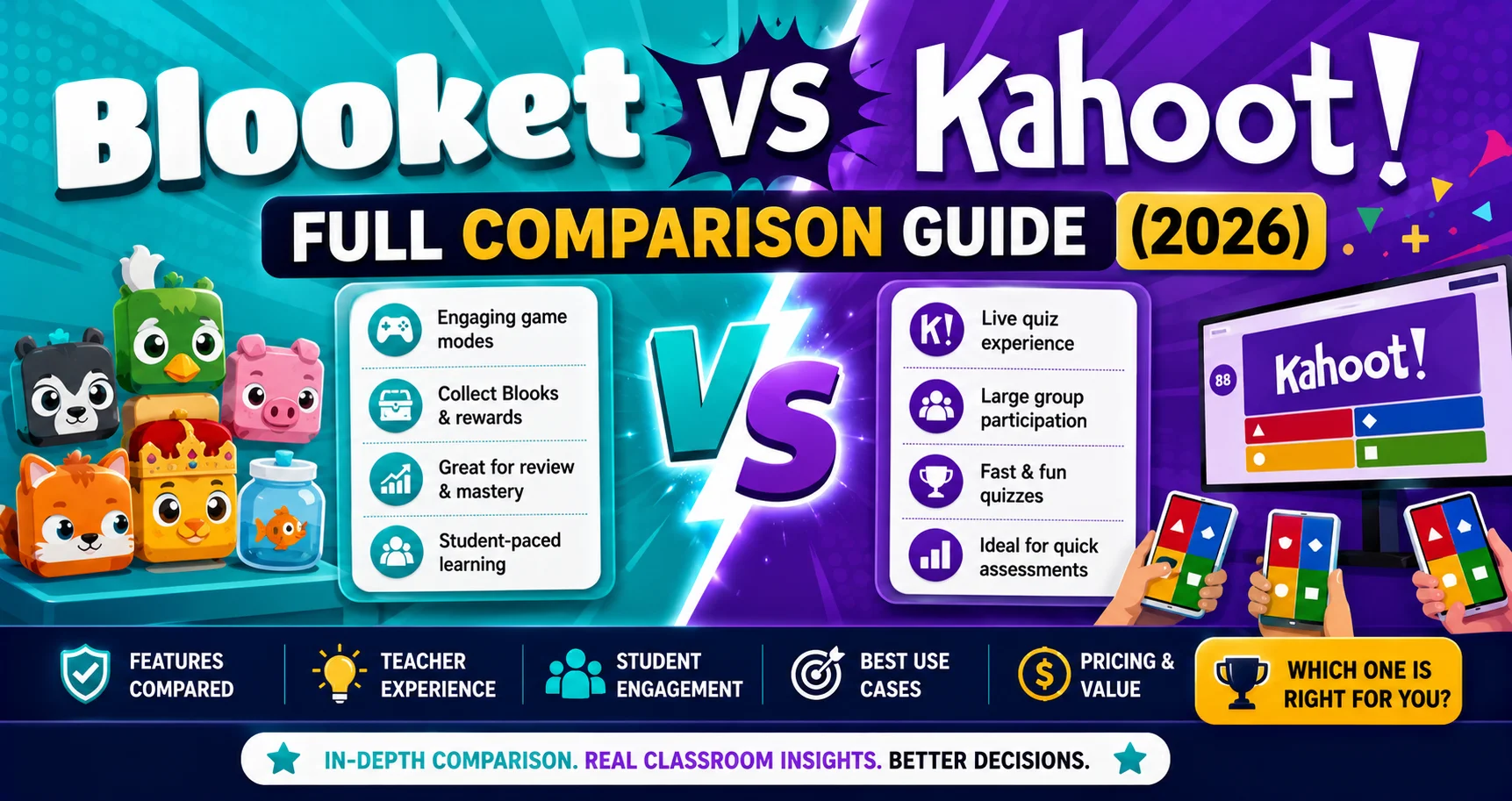
→ Blooket wraps the same multiple-choice question format in more than 18 different mini-games. Tower Defense, Café, Gold Quest, and Factory each feel completely different, even when reusing the same question set. Students answer at their own pace within the game mode’s mechanics rather than racing against a single shared clock.
→ Kahoot centers on a single, well-known live-quiz format: a question projects on a shared screen, and players race to answer correctly and quickly from their own device. Kahoot has since added team play, a slower “accuracy” mode that rewards correctness over speed, and presentation-style formats for non-quiz content. But the core experience remains built around a synchronized, projector-driven session.
Blooket vs Kahoot: Pricing Comparison
Kahoot’s pricing is genuinely more complex than Blooket’s, since it splits into several tiers based on player-count needs:
- Kahoot! Go (free): 40 participants, includes basic reports and assignable Kahoots with a deadline.
- Kahoot!+ Bronze: $3/month billed annually ($36/year), 50 participants, adds AI content-creation tools.
- Kahoot!+ Silver: $7/month billed annually ($84/year), 100 participants.
- Kahoot!+ Gold: $12/month billed annually ($144/year), 200 participants, adds deadline-free assignments.
- Kahoot! One: $19/month billed annually ($228/year), 800 participants, full AI toolkit.
Blooket uses a single paid tier:
- Free (Starter): 60 players.
- Blooket Plus: $4.99/month billed annually ($59.88/year), 300 players (except Racing and team modes), all Plus features included at one price.
For a classroom that needs to host more than 100 players in a single live session, Blooket Plus reaches that capacity at a noticeably lower annual cost than the Kahoot tier with matching capacity. For smaller groups under 50 players, Kahoot’s Bronze tier is the cheaper entry point.
Player Limits and Group Size
This is one of the clearest practical differences between the two platforms:
- Blooket’s free tier (60 players) already exceeds Kahoot’s free tier (40 players) without any payment.
- Kahoot’s per-tier player limits scale more gradually (40, 50, 100, 200, 800), letting a school pay for exactly the capacity it needs.
- Blooket’s structure is simpler: one paid tier covers up to 300 players, with no intermediate steps.
Large single-session classes, assemblies, or grade-wide events favor Blooket’s higher free-tier cap, and single-tier paid jump to 300. Smaller, more granular scaling needs may fit Kahoot’s stepped-tier structure better.
Homework and Self-Paced Learning
Both platforms support assigning content for students to complete outside of live class time, but with different depth:
→ Blooket offers homework assignments with a Correct Goal system on every tier, with the deadline window extending from 14 days (free) to 365 days (Plus).
→ Kahoot also allows assigning kahoots on its free tier, but assignments include a deadline by default; removing the deadline requirement specifically requires the Gold tier or above.
Which One Fits Your Classroom?
→ Choose Kahoot if:
- Your sessions are primarily live, teacher-led, and projector-driven.
- You want access to a massive existing question library and AI-assisted content creation.
- Your typical group size is under 50 players.
- You’re building interactive presentations, not just quizzes.
→ Choose Blooket if:
- You want variety across many mini-game formats rather than one format.
- Students benefit from self-paced play within a live session.
- Your group sizes regularly exceed 100 players and cost matters at that scale.
- Homework assignments are a core part of how you use the platform.
Consider using both: Many teachers use Kahoot for quick, high-energy review sessions and Blooket for longer practice sessions or homework, since question sets often transfer between quiz-based platforms with minimal rework.
Scenario-by-Scenario Breakdown
→ Elementary classroom, whole-class review before a test. Kahoot’s simple, familiar live format works well here, since younger students recognize the format instantly and the fast-paced scoring keeps energy high for a short session. Blooket works equally well if you want more visual variety across multiple short review rounds, since switching game modes between rounds keeps the same material feeling fresh.
→ Middle or high school, self-paced station rotation. Blooket fits this better. Its game-mode variety means different stations can run different mini-games from the same or different question sets, and its per-session flexibility doesn’t require every student to be on the same question at the same time the way Kahoot’s classic live mode does.
→ Substitute teacher or one-off guest lesson. Kahoot’s single, well-known format is easier to hand off to someone unfamiliar with either platform, since there’s only one game mechanic to explain. Blooket’s variety, while a strength for regular users, adds a small learning curve for someone hosting a single unfamiliar session.
→ School-wide assembly or grade-level trivia event. Blooket’s higher free-tier player cap (60 versus 40) and its ability to reach 300 players on a single paid tier make it the more practical and cost-effective choice for large one-time events, without needing to jump to Kahoot’s most expensive tier.
→ Flipped classroom or heavy homework reliance. Blooket’s homework mode, with deadlines ranging from 14 to 365 days depending on tier, is available at every price point including free. Kahoot also supports assignments on its free tier, but removing the deadline requirement specifically requires the Gold tier, so budget-conscious teachers leaning heavily on deadline-free homework may find Blooket’s model simpler to plan around.
→ Building original content from scratch frequently. Kahoot’s AI-assisted question generation (available starting at the Bronze tier) can speed up building new question sets, which is a genuine advantage for teachers who write fresh content often rather than reusing existing sets. Blooket does not currently offer this AI-assisted creation tool, so building large sets from scratch takes more manual time on Blooket.
→ Tight or no budget, maximizing free-tier value. Blooket’s free tier offers a higher player cap (60) than Kahoot’s free tier (40) at no cost, along with homework assignments included. For a teacher who can’t justify any paid subscription, Blooket’s free tier currently offers slightly more room to work with.
→ Corporate training or large non-classroom events. Kahoot has a longer track record and broader brand recognition outside of K-12 education specifically, including dedicated event and business use cases. For contexts outside a typical classroom, Kahoot’s established presentation features and general familiarity may carry more practical weight than the classroom-specific comparisons above.
Blooket vs Kahoot: Pros and Cons
Blooket Pros:
- Extensive game-mode variety (18+ distinct formats) keeps repeated review sessions feeling fresh.
- Simpler single-tier pricing makes budgeting predictable; no separate tiers to compare.
- Higher free-tier player cap (60) than Kahoot’s free tier.
- Homework assignments available on every tier, including free.
- Reaches 300 players at a lower annual cost than Kahoot’s equivalent-capacity tier.
Blooket Cons:
- No AI-assisted question generation; building sets from scratch takes more manual time.
- Smaller built-in, ready-made question library compared to Kahoot’s half-billion-question bank.
- Less brand recognition outside K-12 classrooms specifically.
- Single game-mechanic style (mini-games) may feel less “traditional” to those expecting a classic live-quiz format.
Kahoot Pros:
- Massive community question library, making it fast to find existing content on almost any topic.
- AI content-creation tools available starting at the bronze tier, speeding up building original sets.
- Polished, widely recognized live-quiz format that’s easy to explain to first-time or substitute hosts.
- Strong presentation-style features for non-quiz interactive content.
- Broader use beyond K-12, including corporate training and events.
Kahoot Cons:
- Lower free-tier player cap (40) than Blooket’s free tier.
- Reaching high player counts (300+) requires jumping to the significantly more expensive Kahoot! One tier.
- Deadline-free homework assignments require the Gold tier or above, not available on lower or free tiers.
- Tiered pricing structure (five separate tiers) takes more effort to compare and choose from than Blooket’s single paid tier.
- Less game-mode variety; sessions can feel repetitive over many uses if relying on the classic format alone.
How Blooket Compares to Other Alternatives
Kahoot isn’t the only option worth weighing against Blooket. See the full Blooket Alternatives comparison guide for an overview of every platform covered, or jump directly to a specific comparison or visit our Blooket Help Center for more.
- Blooket vs Gimkit: best for classrooms that respond to an in-game currency and shop system.
- Blooket vs Quizizz (Wayground): best for self-paced assignments and AI-assisted content creation.
- Blooket vs Quizlet Live: best if your class already studies with existing Quizlet flashcard sets.
Frequently Asked Questions
Is Blooket or Kahoot better for large classes?
Blooket’s free tier allows 60 players versus Kahoot’s 40, and Blooket Plus reaches 300 players at a lower annual cost than the Kahoot tier needed for a comparable player count. For consistently large groups, Blooket’s pricing structure is generally more cost-effective.
Which is cheaper, Blooket Plus or Kahoot’s paid plans?
It depends on your player-count needs. For under 50 players, Kahoot’s Bronze tier ($36/year) is cheaper than Blooket Plus ($59.88/year). For 100 or more players, Blooket Plus becomes the more cost-effective option compared to Kahoot’s higher tiers.
Can I use the same question sets on both platforms?
Not automatically. Each platform has its own question-set format and library, so sets typically need to be rebuilt or manually re-entered when switching between Blooket and Kahoot, though the underlying multiple-choice content transfers conceptually with minimal rework.
Which is better for homework or self-paced review?
Both support assigning content outside of live sessions. Blooket allows deadline-flexible homework (14 to 365 days) on every tier. Kahoot allows assignments on every tier too, but a fully deadline-free assignment specifically requires Kahoot’s Gold tier or above.
Does either platform work without a student account?
Yes, both. Students can join a live Blooket or Kahoot game as a guest without creating an account. Account creation on either platform is optional and mainly unlocks progress tracking and cosmetic rewards.
Which platform has more game-mode variety?
Blooket, by a significant margin. Blooket offers 18 or more distinct mini-game formats, while Kahoot centers on one core live-quiz format with team, accuracy, and presentation variations layered on top.
Can I switch between the two platforms without losing my content?
Your account data on each platform stays with that platform; switching doesn’t transfer question sets or history automatically. However, most multiple-choice question banks can be manually recreated on the other platform without starting from scratch conceptually, since the underlying question-and-answer structure is similar.