Blooket vs Gimkit: Complete Comparison Guide for 2026
Last verified: September 5, 2026
Quick Answer: Gimkit is the stronger pick for classrooms that respond well to earning and spending in-game currency, with a strategic shop layer built into every session. Blooket is the stronger pick for larger free-tier groups, simpler pricing, and homework assignments available on every tier, not just the paid one. Both cost about the same at their entry paid tier, so the real difference comes down to game mechanics and what your free tier actually needs to cover.
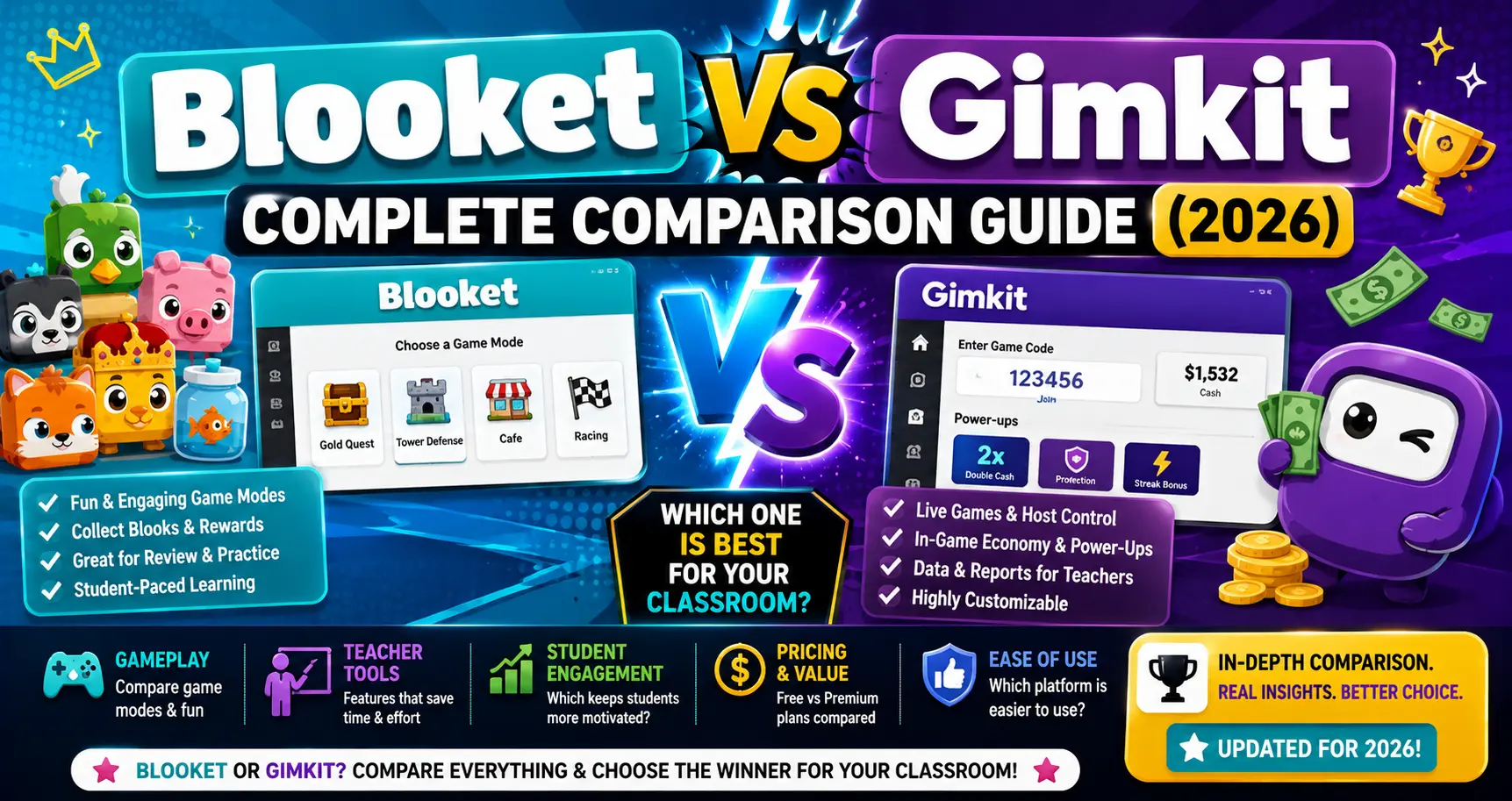
Blooket and Gimkit both turn quiz questions into competitive classroom games, but they build the experience around very different core mechanics. Gimkit centers on an in-game economy; Blooket centers on variety across many distinct mini-games. This guide compares Blooket vs Gimkit across pricing, player limits, game mechanics, and homework support.
Source: verified from Blooket’s official documentation and Gimkit’s official pricing page.
Blooket vs Gimkit: Quick Comparison Table
| Feature | Blooket | Gimkit |
| Free plan player limit | 60 players | Unlimited on rotating free modes; Pro-exclusive modes capped at 5 |
| Cheapest paid tier | $4.99/month ($59.88/year) | $14.99/month or $59.88/year ($4.99/month annual) |
| Player limit on paid tier | 300 (except Racing/team modes) | Up to 60 on certain 2D modes; higher on others |
| Core game mechanic | 18+ distinct mini-game modes | Single in-game currency and shop system |
| Homework/async mode | Yes, on all tiers (14-day free, 365-day Plus) | Pro tier only; not available on free Basic |
| Free trial | Not applicable (free tier is permanent) | 14-day free trial of Pro for new accounts |
| Group/school pricing | Not tiered separately | Department: $650/year (20 teachers); School: $1,000/year |
How Each Platform Actually Works
→ Blooket wraps the same multiple-choice question format in more than 18 different mini-games, from Tower Defense to Café to Gold Quest. Each mode feels mechanically distinct, even when using the same question set, and students largely play at their own pace within each mode.
→ Gimkit centers on a single core mechanic across most of its modes: students earn in-game currency for correct answers, then spend it in a shop on upgrades, power-ups, or strategic advantages that affect their performance for the rest of the session. This turns a quiz into an ongoing economic strategy game layered on top of the questions themselves.
Gimkit offers multiple game modes (including a builder-style mode and various themed variations), but the currency-and-shop mechanic is the platform’s defining feature across nearly all of them.
Blooket vs Gimkit: Pricing Comparison
→ Blooket uses a single paid tier:
- Free (Starter): 60 players, all core features including homework assignments.
- Blooket Plus: $4.99/month billed annually ($59.88/year), 300 players (except Racing and team modes).
→ Gimkit’s structure is different:
- Free (Basic): Unlimited play on rotating free game modes; Pro-exclusive modes are capped at 5 players until upgrading.
- Gimkit Pro: $14.99/month, or $59.88/year billed annually (which works out to $4.99/month, an identical annual rate to Blooket Plus).
- Group plans: Department ($650/year for up to 20 teachers) and School ($1,000/year covering an entire building).
At the annual-billing rate, Blooket Plus and Gimkit Pro cost the same per month. The real pricing difference shows up in what each free tier actually unlocks: Blooket’s free tier includes homework assignments and a 60-player cap across all modes, while Gimkit’s free tier restricts Pro-exclusive modes to just 5 players and doesn’t include assignments at all.
Player Limits and Group Size
- Blooket’s free tier supports 60 players across all its game modes without restriction.
- Gimkit’s free tier is technically unlimited for its rotating free modes, but any Pro-exclusive mode caps hard at 5 players, which is too small for a full classroom.
- On paid tiers, some Gimkit 2D game modes cap at 60 players regardless of plan, a technical limit rather than a pricing one.
- Blooket Plus reaches 300 players on its single paid tier, well above Gimkit’s typical per-mode caps.
For a classroom that wants to use every available game mode with a full class from day one, Blooket’s flat 60-player free-tier access covers more ground without requiring an upgrade.
Homework and Self-Paced Learning
This is one of the clearest differences between the two platforms.
→ Blooket includes homework assignments with a Correct Goal system on every tier, including free, with deadline windows from 14 days (free) to 365 days (Plus).
→ Gimkit’s assignment feature, which lets students complete self-paced work built from any kit with due dates and completion tracking, is only available on the paid Pro tier. Free Basic accounts do not have access to Gimkit’s homework/assignment feature at all.
For any teacher planning to rely heavily on homework or self-paced review without committing to a paid subscription first, this is a meaningful difference in what the free tier actually offers.
Which One Fits Your Classroom?
Choose Gimkit if:
- Your students respond strongly to earning and spending in-game currency as a motivator.
- You’re comfortable starting on Pro (or using the 14-day trial) to access the full mode library from day one.
- Group licensing for a whole department or school is on the table.
Choose Blooket if:
- You want your free tier to include homework assignments without upgrading first.
- Your full class (up to 60 players) needs access to every game mode without hitting a small player cap.
- You prefer a single, simple paid tier rather than deciding between individual and group Gimkit pricing.
Scenario-by-Scenario Breakdown
→ New teacher testing the waters before committing to a subscription. Blooket’s free tier gives full access to all game modes for up to 60 players, plus homework assignments, with nothing held back for a trial period. Gimkit’s free tier restricts Pro-exclusive modes to 5 players, so a full evaluation of Gimkit’s complete library realistically requires using the 14-day Pro trial.
→ A classroom that thrives on competition and strategy, not just speed. Gimkit’s currency-and-shop system adds a layer of strategic decision-making that some students find more engaging than a pure speed-and-accuracy race. If your class responds well to resource management and long-game thinking, Gimkit’s mechanic is a genuine differentiator Blooket doesn’t replicate.
→ Heavy homework or flipped-classroom users on a tight budget. Blooket is the clearer fit here, since homework assignments are included on its free tier. Achieving the same on Gimkit requires the Pro subscription, adding a cost that Blooket doesn’t require for this specific use case.
→ School or department buying licenses for multiple teachers. Gimkit’s Group plans (Department at $650/year for 20 teachers, School at $1,000/year building-wide) offer a built-in, clearly priced group option. Blooket doesn’t currently offer an equivalent tiered group-licensing structure, so schools comparing bulk options may find Gimkit’s group pricing easier to plan around at scale.
→ Teacher who wants maximum game-mode variety without hitting small caps. Blooket’s 18+ modes are all available to the full 60-player free tier. Gimkit offers meaningful variety too, but several of its most popular modes are Pro-exclusive and capped at 5 players until upgrading, which limits how much of that variety a free-tier classroom can actually use.
Blooket vs Gimkit: Pros and Cons
Blooket Pros:
- Homework assignments included on the free tier, not gated behind a paid plan.
- Full 60-player access to all game modes without upgrading.
- Simple single-tier pricing with no group-plan decision to make.
- Wide mini-game variety keeps repeated sessions feeling different.
Blooket Cons:
- No in-game currency or shop-style strategic layer.
- No dedicated group/department licensing tier.
Gimkit Pros:
- Distinctive in-game currency and shop mechanic adds strategic depth.
- 14-day free Pro trial lets new users test the full library before paying.
- Clear group-licensing options for departments and whole schools.
- Same annual-equivalent price as Blooket Plus at the individual level.
Gimkit Cons:
- Free tier caps Pro-exclusive modes at just 5 players.
- Homework/assignment feature requires a paid Pro subscription; not available for free.
- Some 2D modes cap at 60 players even on paid tiers.
How Blooket Compares to Other Alternatives
Gimkit isn’t the only option worth weighing against Blooket. See the full Blooket Alternatives comparison guide for an overview of every platform covered, or jump directly to a specific comparison or visit the Blooket Help Center for more details.
- Blooket vs Kahoot: best for live, projector-driven sessions with a massive question library.
- Blooket vs Quizizz (Wayground): best for self-paced assignments and AI-assisted content creation.
- Blooket vs Quizlet Live: best if your class already studies with existing Quizlet flashcard sets.
Frequently Asked Questions
Is Blooket or Gimkit cheaper?
At the individual annual-billing rate, they cost the same: $4.99/month ($59.88/year) for both Blooket Plus and Gimkit Pro. The pricing difference shows up in what each free tier includes rather than in the paid-tier cost itself.
Does Gimkit have a free trial like a demo period?
Yes. New Gimkit accounts typically start with a 14-day free trial of Pro, after which the account reverts to the free Basic tier unless a subscription is purchased. Blooket’s free tier has no expiration or trial period; it’s simply free indefinitely.
Can I assign homework on Gimkit’s free plan?
No. Gimkit’s assignment feature, which allows self-paced homework with due dates, requires the paid Pro tier. Blooket includes homework assignments on its free tier as well as Plus.
What makes Gimkit’s game mechanic different from Blooket’s?
Gimkit centers on an in-game currency and shop system: students earn money for correct answers and spend it on upgrades within the same session. Blooket instead offers variety across 18 or more distinct mini-game formats without a unified currency mechanic running through all of them.
Is there a group or school pricing option for Blooket like Gimkit’s Department and School plans?
Not currently in the same tiered structure. Gimkit offers Department ($650/year for 20 teachers) and School ($1,000/year building-wide) plans specifically. Blooket’s pricing is currently structured around individual Plus subscriptions rather than separate group tiers.
How many players can join a Gimkit game on the free plan?
It depends on the mode. Rotating free game modes have no specific player cap tied to the plan itself, but any Pro-exclusive mode is limited to 5 players on the free Basic tier.
Which platform is better for a first-time user with no budget yet?
Blooket, generally, since its free tier already includes homework assignments and full access to all modes for up to 60 players. Gimkit’s free tier is more restrictive outside of its rotating free modes, though its 14-day Pro trial offers a way to test everything before deciding.