
Poker Solvers Have Changed How Pros Play and the Sites Are Adapting
Before solver software became standard study equipment, many difficult poker decisions remained open to argument. Professionals compared hand histories, debated bet sizes, and relied heavily on experience to judge whether an unconventional line was strong or simply fashionable.
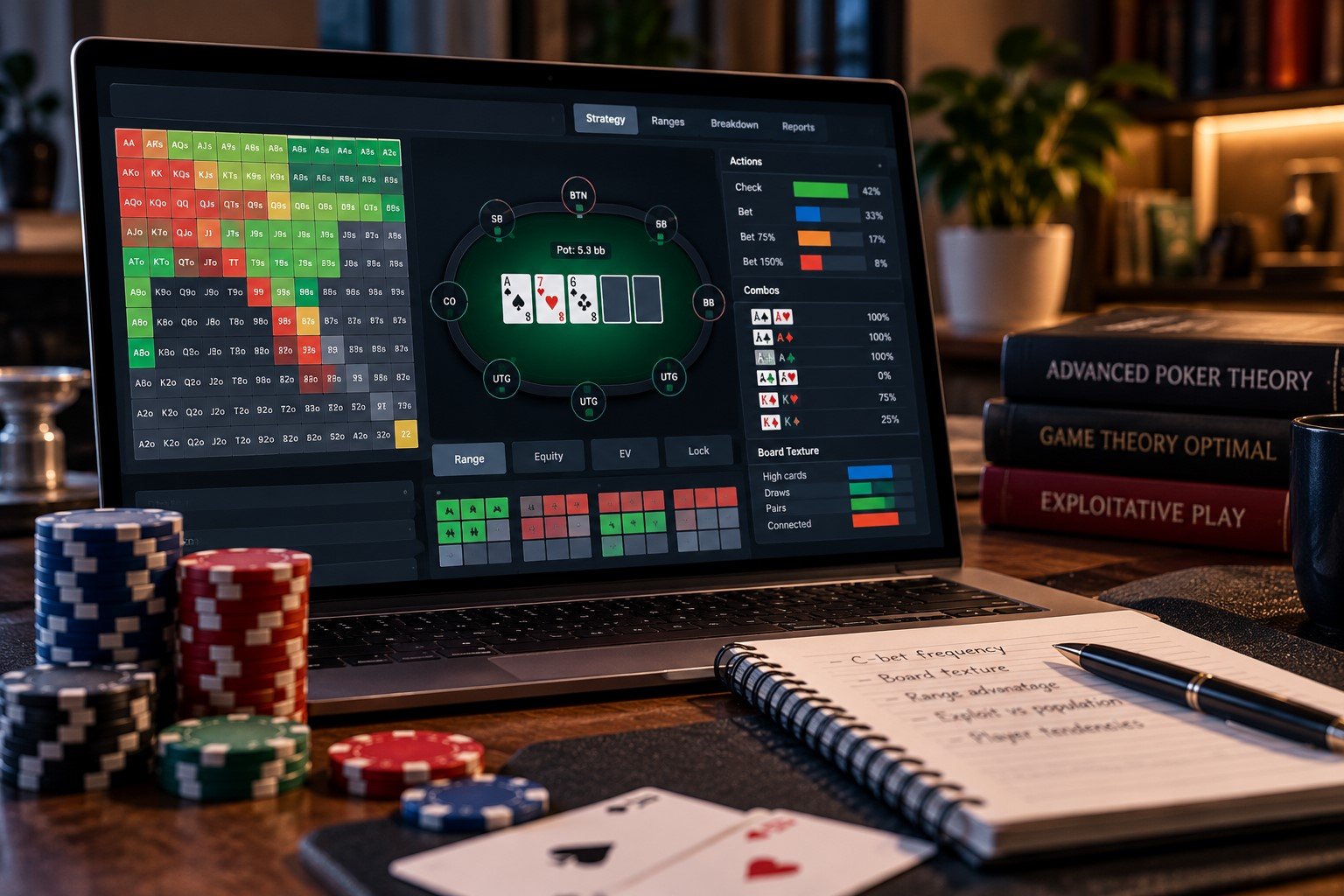
Commercial solver software changed that in the mid-2010s by giving players a practical way to calculate strategies for complex post-flop situations. Modern poker study became less concerned with finding a single “correct” move and more concerned with how entire ranges should bet, check, call, or raise at different frequencies.
That altered professional play. It also created a harder question for online operators: how do you distinguish someone who has studied solver output extensively from someone receiving that output while a hand is still in progress?
From disputed spots to calculated strategies
A solver does not produce the equivalent of a basic strategy chart. It builds a model of a situation and distributes actions across a range. One hand may bet frequently, another only occasionally, while a third may mix several sizes.
That framework settled questions that had once depended largely on intuition.
Its influence became easy to spot. Small continuation bets appeared on boards where older strategy often favoured larger sizing. River overbets became more common. Hands that once looked too weak to bluff began appearing at carefully controlled frequencies because they performed a specific function inside the overall range.
The vocabulary of professional analysis changed with it. Strong players stopped discussing hands mainly in terms of “what does he have?” and started asking what combinations an opponent should still reach a particular street with after the previous sequence of actions.
Computer-poker research pushed the same idea further. Libratus and DeepStack defeated professional opposition in heads-up formats in 2017. Pluribus followed in 2019 by succeeding against professionals in six-player games, where several opponents make equilibrium calculation much more difficult.
When solver outputs became normal study material
Early solver work required substantial computing resources and patience. Later browser-based tools removed much of that barrier by offering large libraries of pre-solved situations.
That changed what counted as basic preparation.
Preflop ranges became more standardized. Bet sizing became less arbitrary. Players could compare thousands of decisions with theoretical baselines rather than relying on whether a play had happened to work in previous sessions.
The result was not that everyone began playing identically. It was that obvious strategic gaps became harder to survive.
A competent regular could no longer depend on memorized starting-hand charts and intuition alone when opponents were studying detailed post-flop solutions. The minimum technical standard moved upward, especially in games populated by experienced regulars.
GTO stopped being the main source of advantage
Once strong baseline strategy became widely available, simply knowing it stopped separating the best-prepared players from the rest.
Game-theory-optimal play is designed to prevent an opponent from exploiting a strategy systematically. It is not designed to extract the greatest possible value from someone who makes repeated, identifiable mistakes.
That distinction matters.
If a player folds too often to large river bets, a professional may bluff more frequently than an equilibrium solution recommends. If a player calls too widely, the adjustment can move in the opposite direction. A solver study establishes the reference point; observation determines whether departing from it is profitable.
Population data extends that process beyond individual opponents. Large hand-history samples can reveal that an entire pool under-defends certain positions, uses predictable bet sizes, or fails to bluff enough in specific lines.
Table selection gains value for the same reason. When technically capable players share similar theoretical foundations, professionals have greater incentive to find opponents whose errors are large enough to exploit.
Why real-time assistance changes the equation
Using solver analysis between sessions and consulting computational advice during a live hand are fundamentally different activities.
Online operators generally allow the first and prohibit the second. Real-time assistance, commonly shortened to RTA, can provide decisions while a player is supposed to be making them independently.
Sites have responded by restricting reference material, limiting tracking software, introducing anonymous seating, and examining decision patterns for signs of external assistance.
The difficult part is that strong study can produce behaviour that resembles machine output.
A player who has reviewed the same situation hundreds of times may reproduce a solver-approved action without consulting anything during the hand. Security systems therefore cannot treat theoretical accuracy by itself as proof of cheating.
They need patterns.
Repeated near-perfect decisions in unusually complex spots, abnormal error rates across large samples, or behavioural changes that appear when certain software is active may provide stronger evidence than any single hand.
The enforcement problem has no clean mathematical line
This creates a problem that solver software cannot solve for the operators themselves.
The better legitimate players become at reproducing equilibrium strategies, the harder it becomes to separate memorized expertise from live computational assistance. Enforcement therefore depends on statistical evidence, account behaviour and detection methods that operators are reluctant to explain in full.
That reluctance has a practical reason. Detailed disclosure could teach cheaters how detection works. Limited disclosure, however, can leave suspended players unable to judge the evidence used against them.
Solver software has therefore changed two systems at once. It has raised the technical standard for professional play and forced online operators to rethink how they police outside assistance.
The defining question is no longer whether a player knows what a solver would do. Serious players are expected to study that material. The relevant question is when that knowledge entered the decision: before the hand through preparation, or during the hand through outside help.
Poker involves financial risk and should be treated as paid entertainment rather than a source of income. Adults who choose to play should set spending and time limits in advance and seek support from an appropriate responsible-gaming service if gambling becomes difficult to control.