What Makes a Backlink Valuable for SEO? Complete Guide
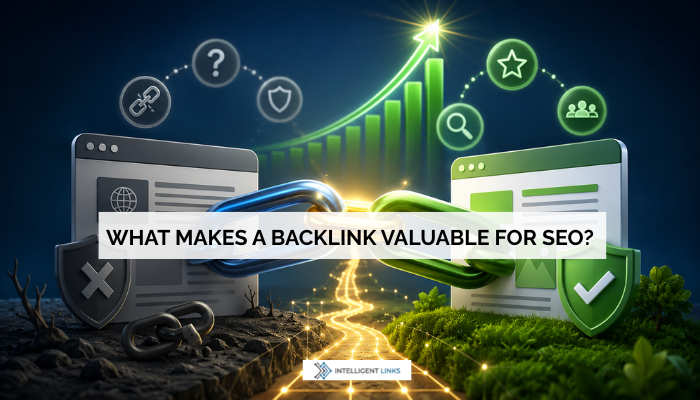
A backlink works like a referral for your site. If it comes from a trusted, relevant source, Google treats it as a vote of confidence and rewards you with better search results. On the flip side, a link from a weak or off-topic site returns little to no ranking value at all.
The moment you understand what separates a valuable backlink from a dead-weight one, your entire link-building strategy changes completely. That’s what Intelligent Links is here to do. We focus on backlinks that push your rankings in the right direction.
Our goal is to help you build a backlink profile that aligns with Google’s quality signals. Unless your site already has a well-established link foundation, a stronger one is just a few steps away. It’s time to treat backlink quality as a priority, rather than an afterthought.
Why Backlink Quality Beats Backlink Quantity
One high-quality backlink from a relevant, trusted site drives more organic traffic and ranking power than fifty weak ones combined. That’s because search engines evaluate the credibility of every link, not just the total number pointing to your site.
To understand why, consider how Google’s algorithms work. Before passing any ranking value to your site, Google assesses how trustworthy and relevant the linking site actually is.
That’s where most site owners trip up early in their link-building journey. In SEO, high-quality backlinks and valuable backlinks mean the same thing. What separates them from weak ones is relevance, authority, and whether the linking site itself ranks well.
As a result, chasing volume without checking quality often hurts your rankings. And once you’ve built a weak link profile, cleaning it up takes far longer than doing it right from the start.
What a High-Authority Linking Page Actually Looks Like
The first thing you’ll notice about a productive linking page is how relevant and well-trafficked it is. A high-authority linking page also includes clean outbound links, solid page-level metrics, and genuine topical relevance.
In this section, we’re going to break down exactly what separates a valuable linking page from a weak one.
Domain Authority Isn’t the Whole Story
Checking page-level authority gives you a sharper picture of how much value a backlink will actually pass. A referring domain might have strong overall domain authority, yet the specific web page linking to you could have zero organic traffic.
In that case, the backlink passes very little value regardless of the domain score. Ahrefs and Semrush show both domain and page-level metrics. That way, you can spot the difference before pursuing any link opportunity.
Follow Links vs. No-Follow Links: What’s the Real Difference?
Do-follow links pass ranking signals directly to your site. That transfer of value is what the SEO community calls link juice, and it’s what pushes your pages higher in search results.
That said, no-follow links carry a different attribute that tells Google not to pass that same value. A dofollow backlink is what you’re after in most cases.
Even so, no-follow links aren’t worthless. Google has confirmed it treats them as hints, and a backlink profile with only do-follow links can look unnatural to search engines.
How to Build High-Quality Backlinks From Trusted Sources
The right outreach method puts your site in front of audiences already interested in your niche. Here are the most reliable ways to build high-quality backlinks:
- Guest Posting: Pitch niche-relevant, authoritative sites for guest post opportunities.
- Original Research: Publish data other sites genuinely want to reference.
- Link Outreach: Use personalised outreach to earn valuable links from trusted sources.
- Editorial Links: Create content that attracts links without direct link-building efforts.
Shortcuts rarely hold up here. We’ve seen firsthand that true effort in every pitch and every piece of content is what earns lasting backlinks.
Anchor Text: The Hidden Signal Behind Every Link
Most site owners overlook anchor text completely, and that’s exactly where a lot of link-building value gets lost. It’s the clickable text that carries a link, and it tells Google what the linked page is about. The three most important things you should know are:
- Relevance Signals: Anchor text reinforces topical relevance and helps Google understand your page’s focus area.
- Over-Optimisation Risk: Repeating exact-match anchor text across many links can trigger a manual penalty and hurt your quality score.
- Natural Mix: A healthy blend of branded, partial-match, and natural anchor text keeps your link juice flowing without raising any flags.
Ultimately, a well-planned anchor text strategy brings you cleaner signals, stronger relevance, and a link profile that Google actually trusts. And with the right mix across your links, you send clear, relevant signals to Google without putting your site at risk.
Your Backlink Profile: How to Read What Google Sees
Your backlink profile is every link pointing to your site, and Google reads it the same way you’d read a CV. A strong link profile tells a clear story of trust, relevance, and authority.
So, how do you assess the strength of your own profile?
First, start by checking backlinks inside Google Search Console. It’s free, reliable, and gives you an honest snapshot of what Google already sees. Then, move to a paid SEO tool or AI tools like the Semrush tool, which pulls from a much wider backlink database and shows richer data.
After that, look specifically for lost backlinks. Any link that drops off your backlink profile is worth a closer look, as it could point to a broken page or a removed mention. Finally, cross-reference your link profile against your competitors’ to find gaps where links pointing to their site aren’t pointing to yours yet.
That’s your full picture. A clean, well-monitored backlink profile is one of the clearest signs of a site Google genuinely trusts.
Guest Posting and External Links: Do They Still Work?
Guest posting gets a bad reputation, but that reputation belongs to people who did it wrong. If it’s done properly, a well-placed guest post on an authoritative site still earns some of the most valuable backlinks available. The problem was never the method. It was always the execution.
With that in mind, a website owner who pitches relevant content to a genuine publication, a news site, or a respected industry community gets published. The guest post is then published on the site, with relevant links placed naturally within the content.
That said, a site owner who blasts the same generic pitch to hundreds of low-quality blogs will get nowhere fast. External links buried in poor content on irrelevant sites pass almost no value at all. Selective, well-researched outreach is what separates a guest posting strategy that builds authority from one that wastes everyone’s time.
Lost Backlinks and Competitors’ Backlinks: What to Do Next
Knowing where your lost backlinks went and where your competitors are getting theirs puts you ahead of most site owners. Both are link opportunities that already exist. Here’s exactly what to do in each situation:
| Situation | What to Do |
| Lost backlinks | Contact the referring domain and request reinstatement |
| Broken pages link | Update or redirect the page, so Google crawls it correctly |
| Competitors’ backlinks from resources pages | Create a stronger, more relevant resource to earn the same backlinks |
| Competitors’ backlinks from news sites | Pitch the same publications with a fresher angle |
| More links needed from a domain | Build a relationship before making another outreach request |
Reclaiming lost backlinks through direct outreach is quicker than building fresh ones from zero. And when it comes to competitors’ backlinks, the goal isn’t to copy their strategy. Instead, you should find the same link opportunities and approach them with something genuinely worth linking to.
Ready to Build Backlinks That Actually Pull Weight?
Now that you know what separates a fruitful backlink from a weak one, the next step is putting that knowledge to work. Quality backlinks come from a clear strategy, consistent outreach, and a genuine focus on relevance over volume. That focus is exactly what separates sites that rank from sites that stall.
Every business deserves a website that Google ranks with confidence. Valuable links from trusted, relevant sources are what get you there, and that’s the kind of link building Intelligent Links specialises in.
Get in touch today to find out how our services can strengthen your backlink profile and push your site toward the rankings it deserves.