Legacy Drawing Conversion for Modern Digital Workflows and Better Project Access
Old paper legacy drawing conversion and vintage file formats tend to pile up on filing shelves and forgotten hard drives, quietly slowing down obligations that could otherwise move much faster. Many shape, engineering, and introduction groups even depend on some years-old blueprints that were never designed to work with state-of-the-art software. That gap between legacy documentation and modern digital equipment creates real problems: lost time, miscommunication, and costly rework.
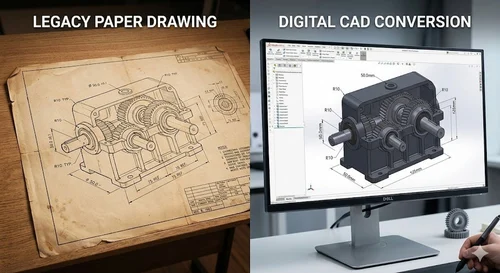
Bridging that gap begins with converting old drawings into formats that contemporary corporations can actually use. Reliable CAD Conversion Services make it possible to convert diminished blueprints and hand-drawn plans into easy, editable digital files that fit right into contemporary formats and production workflows. Once that basis is in place, the whole thing downstream, from planning to execution, will become drastically smoother.
Why Legacy Drawings Create Bottlenecks Today
Paper drawings and old CAD versions were not built with collaboration in mind. When a mission organization pulls up a drawing from twenty years in the past, they often find lacking layers, incompatible file types, or measurements that do not translate cleanly into modern-day necessities. This forces companies to redraw entire sections from scratch, which eats up hours that might flow into closer to actual assignment artwork.
The problem compounds when multiple stakeholders want to get entry to the same records. Contractors, architects, and estimators all need a shared reference item, and a scanned PDF or a torn blueprint in reality could not lessen it.
Digitizing that information isn’t always quite as much of a consolation anymore; ithas becomes a sensible necessity for keeping obligations on time and within budget. Teams that push this venture down the priority list frequently find themselves shopping it later, at the same time as a rushed deadline exposes simply how much friction old documents were causing all along.
The Ripple Effect on Project Planning and Estimating
Once drawings are converted and standardized, the benefits amplify properly past the format phase. Accurate digital documents make it a long way much less complex to generate reliable material takeoffs, difficult artwork estimates, and assignment timelines.
This is in particular right for groups that choose to outsource construction estimating, due to the fact that estimators rely closely on smooth, well-prepared drawings to provide numbers that hold up under scrutiny. When the underlying documentation is messy or incomplete, even professional estimators end up guessing, and guesswork has a way of becoming cost range overruns down the road.
There’s additionally a scheduling gain really worth bringing up. Projects that start with well-converted drawings tend to move through approval and bidding stages faster; in fact, due to the fact every person worried is working from the same correct source, fewer clarification requests arise, and fewer delays mean a project stays on its actual timeline.
Choosing the Right Partner for Conversion and Estimating Work
Not every issuer handles legacy drawing conversion or estimating work the same way, so it can pay to be selective. Look for a crew with a track record of accuracy, smooth communication, and revel in at some point of some of project types, from residential builds to massive industrial developments. An enterprise employer like NEDES Estimating brings that type of specialised experience to the desk, combining conversion expertise with authentic information on the way estimating and documentation intersect.
Location and enterprise familiarity matter too. Firms presenting plumbing-estimating services, Construction estimating Services Austin professionals depend upon that to recognize local building codes, material costs, and local market conditions- ways that time-honored, one-size-fits-all carriers simply do not. That local understanding ought to make a measurable difference in terms of generating estimates that simply replicate real-world costs.
What a Smooth Conversion Process Looks Like
A well-run conversion process typically begins with an assessment of the correct documents to evaluate quality and completeness. From there, the drawings are digitized, cleaned up, and prepared into layers that replicate contemporary CAD requirements. The aim is not simply to create a digital duplicate of an antique drawing; it’s to offer a file that’s definitely usable for design revisions, cost estimating, and long-term archiving.
Quality tests need to be considered at every stage. Dimensions need to be tested, annotations need to be legible, and document codecs need to wholesome something software the receiving organization actually uses. Skipping those steps may also save a bit of time earlier, but it nearly always creates more work later when errors groundmid-project.
Long-Term Value Beyond the Immediate Project
Converting legacy drawings is not just a one-time restore for a unmarried manner. Once a project’s documentation is digitized, it will become a reusable asset for future renovations, expansions, or preservation work. Facility managers and asset owners in particular gain from having a clean digital archive, as it saves them from repeating the same conversion process on every occasion a new task comes up.
There’s moreover a broader performance benefit throughout an industrial organisation. Teams that standardize their drawing formats early typically tend to spend tons less time troubleshooting compatibility issues and more time virtually designing, constructing, and estimating. That shift in cognizance, from solving antique problems to solving new ones, has a tendency to pay for itself frequently over time.
Final Thoughts
Legacy drawings do not need to be a permanent source of friction. With the proper conversion approach, vintage blueprints end up as a true asset instead of a legal responsibility, setting in place smoother collaboration, more accurate estimating, and fewer surprises as a project gets underway. Whether a group is digitizing a single set of plans or overhauling years of gathered documentation, investing in the right conversion approach will pay off throughout the entire life of a project.
FAQs
What record codecs can vintage drawings be converted into?
Most conversion groups can output formats like DWG, DXF, or PDF, depending on the software a group plans to apply going forward.
How long does drawing conversion normally take?
Timelines vary primarily based on the size and complexity of drawings, but small batches regularly take only a few days, while large batches can take several weeks.
Does converting vintage drawings enhance accuracy for price estimating?
Yes, cleaner and more precise digital drawings provide estimators a reliable basis for takeoffs, which reduces the risk of expensive miscalculations.
Can hand-drawn or damaged blueprints be transformed?
In most cases, experienced vendors can work with damaged, torn, or hand-drawn files, even though intentionally broken originals may require extra time for cleanup.
Is it truly worth changing drawings for obligations that aren’t energetic, however?
Absolutely. Having digitized statistics ready beforehand speeds up planning and estimating whenever a project slips in advance.