
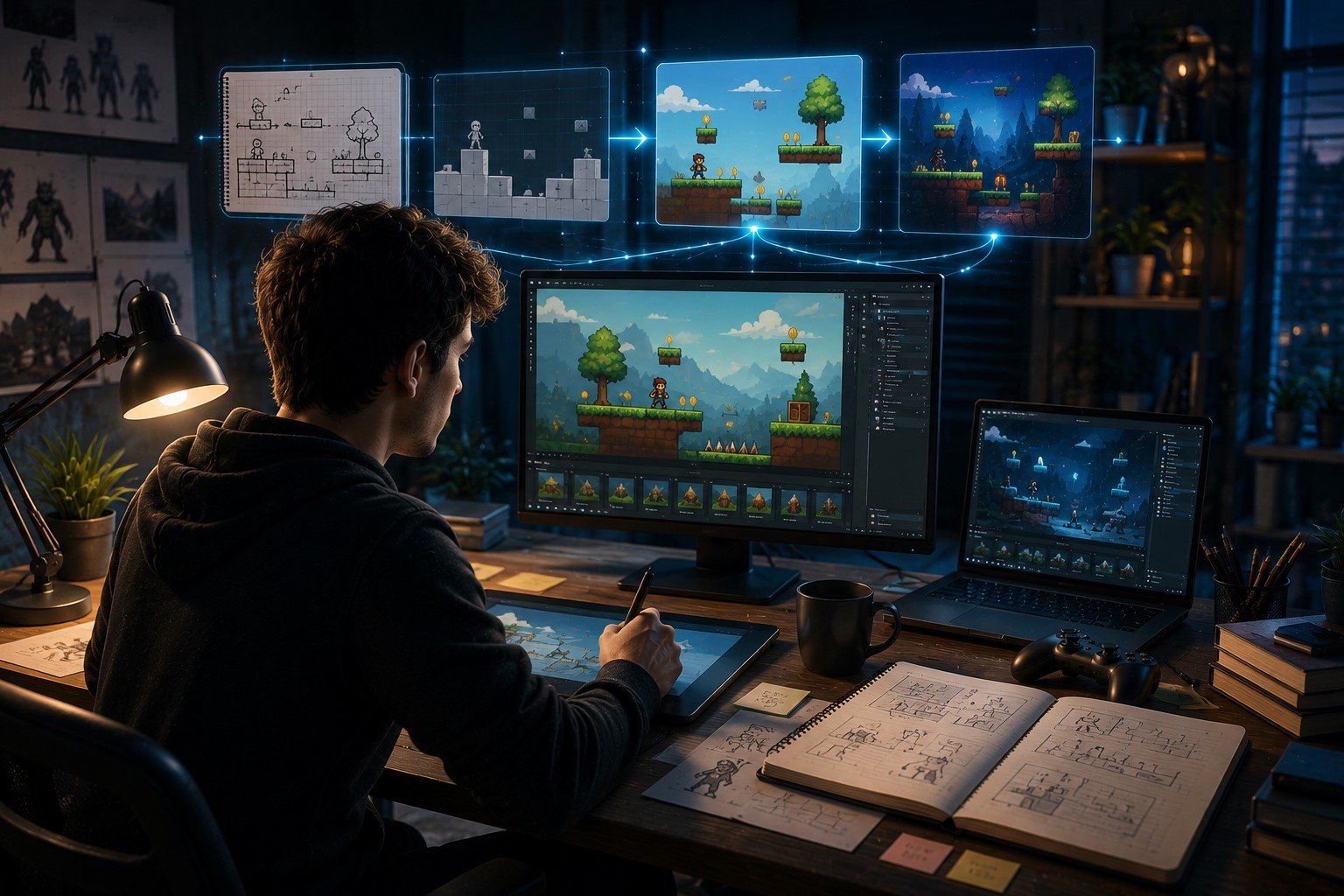
The Smart Way to Start Building Games with AI
Most people who want to make games with AI get stuck before they ever build anything, not because the idea is bad, but because the starting point feels overwhelming. Which engine? Which language? Which tutorial series? That decision paralysis kills more first projects than any actual technical difficulty does. AI tools have quietly removed a lot of that friction, but only if you approach them the right way.
What is the smart way to start building games with AI?
There’s a smart way to start, and there’s a way that just recreates the same overwhelm with different tools. Here’s how to do the former.
Why “Just Start” Doesn’t Work Without a Plan
Jumping straight into any tool, AI-assisted or not, without a clear sense of what you’re building tends to produce the same result: an unfocused project that grows in random directions until it stalls. AI removes technical friction, but it doesn’t remove the need for a clear starting point. Speed without direction just means arriving at confusion faster.
Step One: Get Specific Before You Open Any Tool
Define the Core Action in One Sentence
Before touching any platform, know exactly what the player does, repeatedly, that makes the game worth playing. “Something with jumping and shooting and maybe crafting” isn’t specific enough to build around. “The player dodges falling obstacles while collecting points” is.
Pick a Genre You Understand as a Player
Building something you’ve genuinely played and enjoyed yourself gives you an internal sense of what “good” feels like for that genre. Trying to build something you’ve only seen described secondhand makes it much harder to judge whether your version is actually working.
Write Down What the Game Won’t Include
Constraints matter as much as the core idea itself. Deciding upfront what you’re not building keeps the project from expanding the moment you get access to tools that make adding features easy.
Step Two: Use AI to Reach a Playable Version Fast
Describe, Don’t Overthink the First Version
The first version doesn’t need to be right; it needs to exist so you can react to it. No-code game maker platforms let you describe your core mechanic in plain language and get something playable back quickly, which is far more useful at this stage than a perfect plan that never gets tested.
Play It Immediately, Not After Adjustments
Resist the urge to tweak before playing. Experience the rough first version exactly as generated, so you can tell what actually needs changing instead of guessing based on how it looks on paper.
Compare Against What You Imagined
The gap between what you pictured and what you got is useful information. Sometimes the AI-generated version reveals a better direction than the one you planned. Sometimes it clarifies exactly what’s missing. Either way, that comparison is where real design thinking starts.
Step Three: Iterate With Intention, Not Just Speed
Test One Change at a Time
It’s tempting to adjust several things at once now that changes are fast. Resist that. Testing one variable at a time is the only way to actually understand what’s making the game better or worse.
Playtest With Someone Else Early
Watch someone unfamiliar with the project play it within the first week. Games like Ragdoll Slingshots show how a simple physics-based core mechanic can carry a huge amount of replay value once the feel is genuinely tuned, and that kind of tuning only comes from watching real reactions, not from internal guessing.
Ask Specific Questions During Testing
Instead of “did you like it,” ask targeted questions: where did you get confused, where did you lose interest, what made you want to try again. Specific answers produce specific improvements. Vague feedback produces vague changes.
Step Four: Know When to Stop Adding and Start Polishing
Recognize When the Core Loop Is Solid
Once the central mechanic feels genuinely satisfying on its own, resist adding more systems on top just because it’s now easy to do so. Additional features should only get added if they clearly strengthen what’s already working, not because building them has become fast and tempting.
Shift Focus to Feel Over Features
Polishing, tightening controls, adjusting timing, refining feedback tends to matter more for a small game’s final quality than any additional mechanic would. This is the stage where deliberate, unhurried attention matters most, even though the tools around you are fast.
Set a Finish Line and Stick to It
Decide what “done” looks like before you get deep into polish, or perfectionism will quietly extend the project indefinitely. A finished small game beats an endlessly refined unfinished one every time.
Mistakes That Undermine a Smart Start
Treating Speed as the Whole Point
Fast iteration is a means, not the goal. Using speed just to generate more unfocused variations without a clear direction wastes the advantage instead of using it well.
Skipping the Planning Step Entirely
AI tools make it tempting to skip upfront thinking and just start generating. Without a clear core idea guiding that process, you end up with a fast, aimless prototype instead of a fast, focused one.
Ignoring Real Player Reactions in Favor of Personal Preference
It’s easy to keep tweaking based on your own taste alone. Real playtesting reactions, even from a small handful of people, reveal problems and strengths that personal judgment alone tends to miss.
A Practical Starting Checklist
- Write your core loop in one sentence before opening any tool.
- Generate a rough playable version and play it immediately.
- Change one thing at a time, and test after each change.
- Get outside eyes on the game within the first week.
- Stop adding features once the core loop feels genuinely solid.
- Set a clear finish line and build toward it deliberately.
Final Thoughts
The smart way to start building games with AI isn’t about using the fastest tool available. It’s about pairing that speed with a clear sense of what you’re building and enough discipline to iterate with intention instead of just momentum.
AI removes the technical friction that used to stand between an idea and a playable version of it. What still separates a good first game from an unfocused one is the thinking that happens around that speed, not the speed itself.
Start with a clear idea, move fast toward a rough version, then slow down enough to make it genuinely good. That order matters more than which tool you use to get there.