Blooket Tower Defense 1 & 2: Complete Strategy Mode Teacher Guide
Last verified: August 10, 2026
Quick Answer: Blooket Tower Defense has students answer questions to earn coins, buy towers from their Blook characters, and defend their base against waves of enemies. Tower Defense 2 adds difficulty settings, two extra maps, and improved visuals. Both are Blooket’s most strategically deep modes, best for longer sessions and grades 4 and up.
Blooket Tower Defence 1 & Tower Defence 2
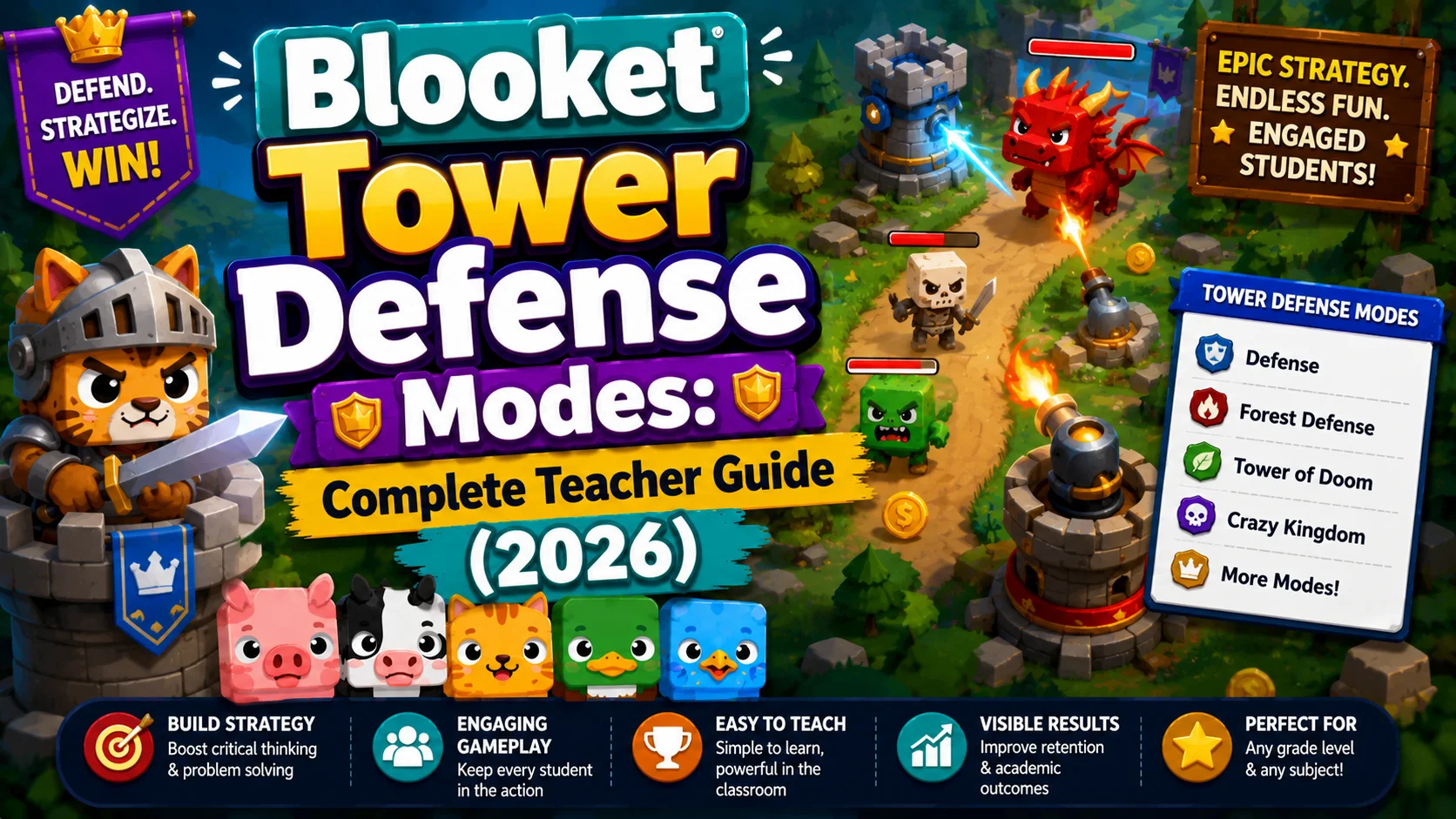
Blooket Tower Defense and its sequel, Tower Defense 2, are the most strategically deep live game modes. They take longer than most other game modes, demand more sustained focus, and reward students who can balance consistent answering with smart strategic decisions. They are also two of the most student-beloved modes on the platform, the kind students ask for by name.
This guide explains how Tower Defense and Tower Defense 2 work, what has changed between them, and how to use them effectively in class.
Complete Overview → Blooket Game Modes for Teachers
Blooket Tower Defense at a Glance
| Stats | Tower Defense 1 | Tower Defense 2 |
| Skills | Strategy and Accuracy | Strategy and Accuracy |
| Difficulty | Complex | Complex |
| Ideal Time | 8 minutes | 10 minutes |
| Questions | Self-Paced, Normal Frequency | Self-Paced, Normal Frequency |
| Min Players | 1 | 1 |
| Ideal Size | 6+ | 6+ |
| Max Players (Free) | 60 | 60 |
| Max Players (Plus) | 300 | 300 |
| Maps | 3 | 5 |
| Save Progress | Yes (Solo/HW) | Yes (Solo/HW) |
| Difficulty Settings | Standard | Easy, Medium, Hard, Nightmare |
How Blooket Tower Defense Works
1. The Core Loop
Blooket Tower Defense is a classic tower defense game. You place defensive towers along a path to stop waves of enemies from reaching your base. In Blooket’s version, this directly ties to your question set:
- Answer a question correctly. Earn coins.
- Spend coins. Buy a tower (your Blook characters become towers).
- Place towers. Position them along the enemy path.
- Towers auto-attack. They fire at enemies walking down the path without further input.
- Enemy waves spawn. Each new wave has more, or more difficult, enemies.
- Defend to the highest round possible.
The key tension: Answering questions quickly gives you more coins, but you also need to stop what you’re doing and place towers strategically. Students who only answer questions (no tower management) and those who only manage towers (and miss questions) both underperform compared to students who balance both.
2. Towers (Blooks as Defenders)
Different Blooks function as different tower types when purchased. Some fire quickly but cause little damage. Some do serious damage but have long cooldowns. Some have area-of-effect abilities that hit multiple enemies. The strategic layer is deciding which towers to buy and where to place them on the map.
Common towers include: Chick (cheapest, entry-level), Frog (mid-tier), and King (most expensive, highest damage). The best Tower Defense players understand which towers provide the best value for their coin generation rate.
3. Enemies
Enemies walk a pre-determined path toward your base. They come in different colors, indicating different speeds and health levels:
- Green/Simple enemies: Slow and low health, appear in early rounds.
- Orange enemies: Fastest enemy type.
- Black/Dark enemies: Highest health, appear in later rounds.
- Slime Monsters (Round 50+): Scaled by formula, appear in extended runs.
If enemies reach your base, you lose base health. Losing all base health ends your game.
4. Maps
Tower Defense 1 has 3 maps:
- Sunny Meadow
- Lost Desert
- Abandoned Mine, all rated Easy difficulty.
Tower Defense 2 expands to 5 maps:
Remade versions of the same three original maps, plus two new maps exclusive to TD2, Fractured Factory (Hard) and Crossroads (Medium).
Step-by-Step → How to Host a Blooket Game
Blooket Tower Defense 2: What’s New
Tower Defense 2 was released as a beta on February 12, 2023, and is now a full, permanent mode. Key differences from TD1:
- Difficulty settings. TD2 lets you select Easy, Medium, Hard, or Nightmare difficulty before the game starts. Nightmare mode features significantly harder enemy waves and is designed for experienced players who want a genuine challenge.
- 5 maps vs. 3. TD2 has more map variety with distinct visual themes and strategic layouts, including two maps not available in TD1.
- Improved weapon variety. Some TD2 weapons are shared with Monster Brawl, giving them a distinct visual identity.
- Fully save-progress compatible. Students can pause and return to their TD2 game in homework mode without losing progress.
Source: verified from Blooket’s official Game Mode Previews documentation.
Why Students Love Blooket Tower Defense
Tower Defense delivers the closest thing to a real video game experience within Blooket. Students who play tower defense games outside of school, such as Bloons Tower Defense or Plants vs. Zombies, find the mode immediately intuitive. Even students who have not played that genre tend to become absorbed by the wave-defense loop.
The mode also creates natural social moments: students helping each other with tower placement strategy during a live session, discussing the best tower combinations, and celebrating surviving a difficult wave together.
Learn Game Mode → Café and Factory Guide
Blooket Tower Defense in the Classroom
→ Use it for longer sessions. Tower Defense takes longer than most Blooket modes. Do not try to squeeze it into 5 minutes. 8 to 12 minutes for TD1, and 10 to 15 for TD2, gives students time to experience the full wave progression.
→ Assign it as homework. The save-progress feature makes Tower Defense ideal for homework. Students can play through multiple sessions before the deadline, picking up where they left off each time.
→ Use TD2 for more experienced players. If students have played TD1 many times and find it easy, TD2 with Hard or Nightmare difficulty provides a fresh challenge.
→ Brief students on tower placement basics. A 60-second explanation before the first TD session (“buy towers in a staggered pattern along the path, not just at one spot”) significantly improves the experience for first-time players.
→ Use it for any subject. Tower Defense’s engaging game layer works regardless of what is in the question set. It is equally effective for math, vocabulary, science concepts, or history review.
Where to Go Next
- Want to learn more about the Blooket? See the Blooket overview
- Want the full teacher toolkit overview? Visit the For Teachers hub
- Introducing this to students directly? See the For Students hub
Have a different question? Check our Frequently Asked Questions or Blooket Help Center
Frequently Asked Questions
What is the difference between Tower Defense and Tower Defense 2?
Tower Defense 2 adds selectable difficulty settings (Easy to Nightmare), two additional maps not found in the original, improved weapon variety, and full save-progress support for homework.
How many maps does each Tower Defense mode have?
Tower Defense 1 has 3 maps. Tower Defense 2 has 5, including remade versions of the original 3 plus two new maps, Fractured Factory and Crossroads.
Is Tower Defense good for younger students?
It works best for grades 4 and up. Its Complex difficulty rating and longer session length can be challenging for very young students, but most upper elementary and secondary students handle it well.
How long should a Tower Defense session run?
8 to 12 minutes for Tower Defense 1, and 10 to 15 minutes for Tower Defense 2, to give students time to experience the full wave progression.
Can Tower Defense be assigned as homework?
Yes. Its save-progress feature is one of the best fits on the platform for homework, since students can play multiple sessions and pick up exactly where they left off.
Do Tower Defense modes require Blooket Plus?
No. Both are available on the free (Starter) plan with the standard 60-player live game cap. Blooket Plus raises that cap to 300 players.
What is Nightmare difficulty in Tower Defense 2?
It is the hardest of four difficulty settings (Easy, Medium, Hard, Nightmare) available in TD2, featuring significantly harder enemy waves for experienced players who want a genuine challenge.