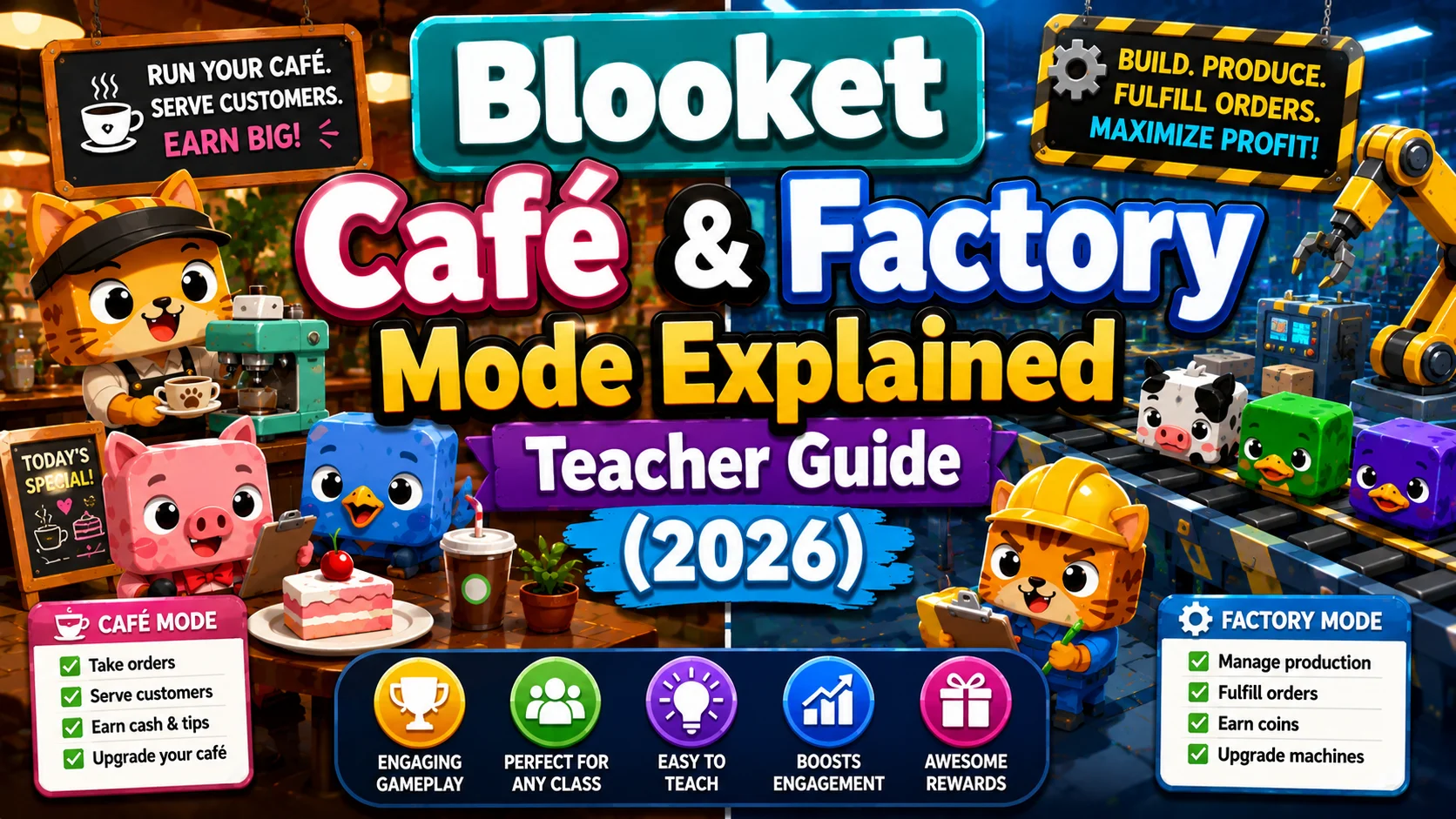
Blooket Café Mode & Factory Mode: Complete Game Guide
Last verified: August 10, 2026
Quick Answer: Blooket Cafe mode has students earn food from correct answers, serve virtual customers, and unlock upgrades, with saved progress for homework. Factory mode has students earn money at high speed and upgrade Blook workers on a production line. Both are resource-building modes best for longer, self-paced sessions.
What is Blooket Café & Factory Mode
Blooket Café Mode and Factory Mode are two “build and upgrade” modes. Both feature a resource loop where correct answers generate in-game currency that you spend to unlock upgrades, which then generate more resources.
Both modes reward consistent answering over time, creating a satisfying compounding progression that keeps students engaged throughout longer sessions. This guide explains how each mode works, when to use them, and how they compare.
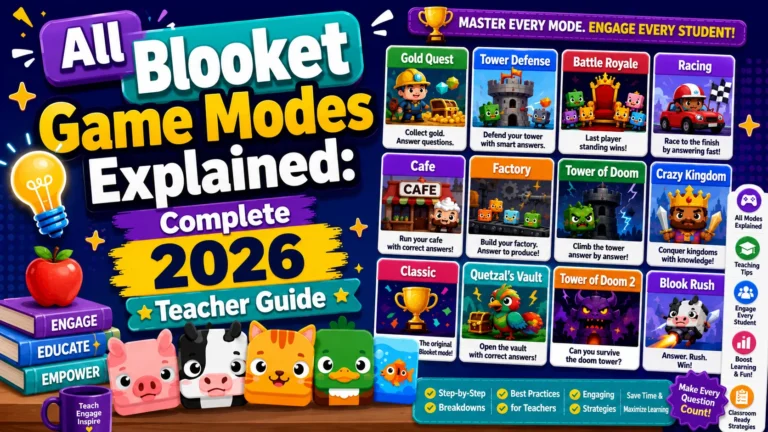
Complete Guide About → All Blooket Game Modes Explained for Teachers
Blooket Café Mode
“Serve Customers and Build Your Virtual Cafe!”
| Stat | Value |
| Skills | Speed and Strategy |
| Difficulty | Normal |
| Ideal Time | 7 to 10 minutes |
| Questions | Self-Paced, Normal Frequency |
| Min Players | 2, ideal 6+ |
| Max Players | 60 free, 300 Plus |
| Save Progress | Yes (Solo and Homework modes) |
| Live + Solo/HW | Both available |
How Blooket Café Mode Works
Cafe turns students into virtual restaurant operators. The game loop:
- Answer a question correctly. Earn a food item (ingredient or menu item).
- Collect food items. Use them to serve virtual cafe customers.
- Serving customers earns coins.
- Spend coins on upgrades. Unlock new menu items, faster service, and more efficient food collection.
- The best cafe (most coins earned) wins.
The upgrade tree creates a progression feel. Early upgrades are cheap and basic; later upgrades are expensive but dramatically increase your earnings rate. Students who answer consistently accumulate resources faster, reach better upgrades earlier, and pull ahead on a compound curve.
Step-By-Step About → How to Host a Blooket Game
Why Cafe is One of Blooket’s Most Popular Homework Modes
Cafe’s save progress feature is the key differentiator for homework use. Students can close their browser mid-game and return later without losing their Cafe progress. This makes it natural for multi-session homework assignments. Students might play for 10 minutes after school, close their laptop, and return for another 10 minutes before bed.
The Correct Goal system (the minimum number of correct answers you set for the homework assignment) pairs naturally with Café because students want to keep playing and upgrading. They often answer well beyond the Correct Goal because they are genuinely engaged with the Café progression.
Classroom Tips for Café Mode
→ Use it for homework more than live games. While Café works as a live game, its full depth shines over longer sessions that live classroom time rarely allows. Homework assignments that give students 30 or more minutes let the upgrade progression unfold properly.
→ Use it before big assessments. “Tonight’s homework is a Cafe review; try to unlock the best menu items” creates a motivating framing for practice that would otherwise feel like a chore.
→ Pair it with focused question sets. Because students may answer many questions (especially with save-progress across multiple sessions), make sure your question set covers the exact content you want them to rehearse.
Learn More About → Blooket Tower Defense Guide
Blooket Factory Mode
“Fast-Paced, Money-Making Madness!”
| Stat | Value |
| Skills | Speed and Strategy |
| Difficulty | Complex |
| Ideal Time | 8 minutes |
| Questions | Self-Paced, High Frequency |
| Min Players | 2, ideal 6+ |
| Max Players | 60 free, 300 Plus |
| Live + Solo/HW | Both available |
How the Blooket Factory Mode Works
Factory mode replaces the cafe setting with an industrial production line. The loop:
- Answer questions at high frequency. Earn money.
- Spend money. Unlock new Blook workers for your production line.
- Each Blook worker has a role. Different roles produce at different rates.
- Upgrade your Blooks. Better upgrades mean faster production and more money.
- Most money produced at game end wins.
Factory mode’s high-frequency question rate is the key difference from Cafe. Students see questions quickly, and answering them faster directly translates into generating money quickly. Students who answer at the same accuracy rate but faster will build a bigger factory.
Factory Strategy: Prioritizing High-Value Workers
Experienced Factory players know that certain Blook workers, like King of Hearts, have a notably high production ceiling once fully upgraded. Students who reach a high-value worker and begin upgrading it early can pull dramatically ahead of players who spread upgrades across many lower-tier workers.
This creates genuine strategic depth for students who play the mode regularly, and it is a good discussion point if you want to teach basic resource-allocation thinking alongside your subject content.
Why Factory Appeals to Different Students Than Cafe
Factory’s high question frequency and Complex difficulty rating make it a stronger fit for students who want speed and challenge. Cafe’s Normal frequency and steady upgrade pacing suit students who prefer a more deliberate build. Both reward accuracy, but Factory rewards those who answer quickly more explicitly.
Classroom Tips for Factory Mode
→ Use it for competitive review sessions. Factory’s high-frequency format drives more raw question repetition per minute than almost any other mode. For a pre-test drill that delivers maximum question volume, Factory delivers.
→ Brief students on the upgrade logic. New Factory players often scatter upgrades randomly. A 30-second tip (“invest in one worker type and upgrade it fully before branching”) improves the experience and creates a more meaningful strategic challenge.
→ Use it for grades 5 and up. Factory’s Complex rating and rapid question pace can overwhelm younger students. Upper elementary and secondary students handle it better.
Café vs. Factory: Which Should You Use
| Scenario | Cafe | Factory |
| Homework assignment | Best (save progress) | Works |
| Fast in-class review | Works | Best |
| Younger students | Better fit | – |
| Challenge-seeking students | – | Better fit |
| Long engagement | Best | Works |
| Maximum question volume | – | Best |
Source: verified from Blooket’s official Game Mode Previews documentation.
Where to Go Next
- Want to know more about the platform? See our Blooket page
- Want the full teacher toolkit overview? Visit the For Teachers hub
- Introducing this to students directly? See the For Students hub
Have a different question? Check our Frequently Asked Questions or Blooket Help Center
Frequently Asked Questions
What is the main difference between Cafe mode and Factory mode?
Cafe uses a normal question pace and rewards steady, longer-term progression with save-progress support. Factory uses a high question frequency and rewards fast, consistent answering for a bigger production line.
Which mode is better for homework?
Cafe mode. Its save-progress feature lets students pause and resume across multiple sessions, which fits naturally with homework assignments that run longer than a typical class period.
What grade levels work best with Factory mode?
Grades 5 and up. Factory’s Complex difficulty rating and fast question pace can overwhelm younger students, while upper elementary and secondary students generally handle it well.
Do Cafe and Factory modes require Blooket Plus?
No. Both modes are available on the free (Starter) plan, with the standard 60-player live game cap. Blooket Plus raises that cap to 300 players.
Can students replay Cafe mode if they lose their internet connection?
Yes, within limits. Cafe’s save-progress feature is designed for planned pauses (closing the browser and returning later), which also helps recover progress after most connection interruptions during solo or homework play.
What is the best strategy for Factory mode?
Focus your money on a small number of high-value workers rather than spreading upgrades thin across many low-tier ones. Concentrated upgrades on strong workers produce more income than a wide, shallow roster.
Can I use the same question set for both Cafe and Factory?
Yes. Like all Blooket modes, both use whatever question set you select. The game mode changes the mechanic, not the content, so one well-built set works across either mode.